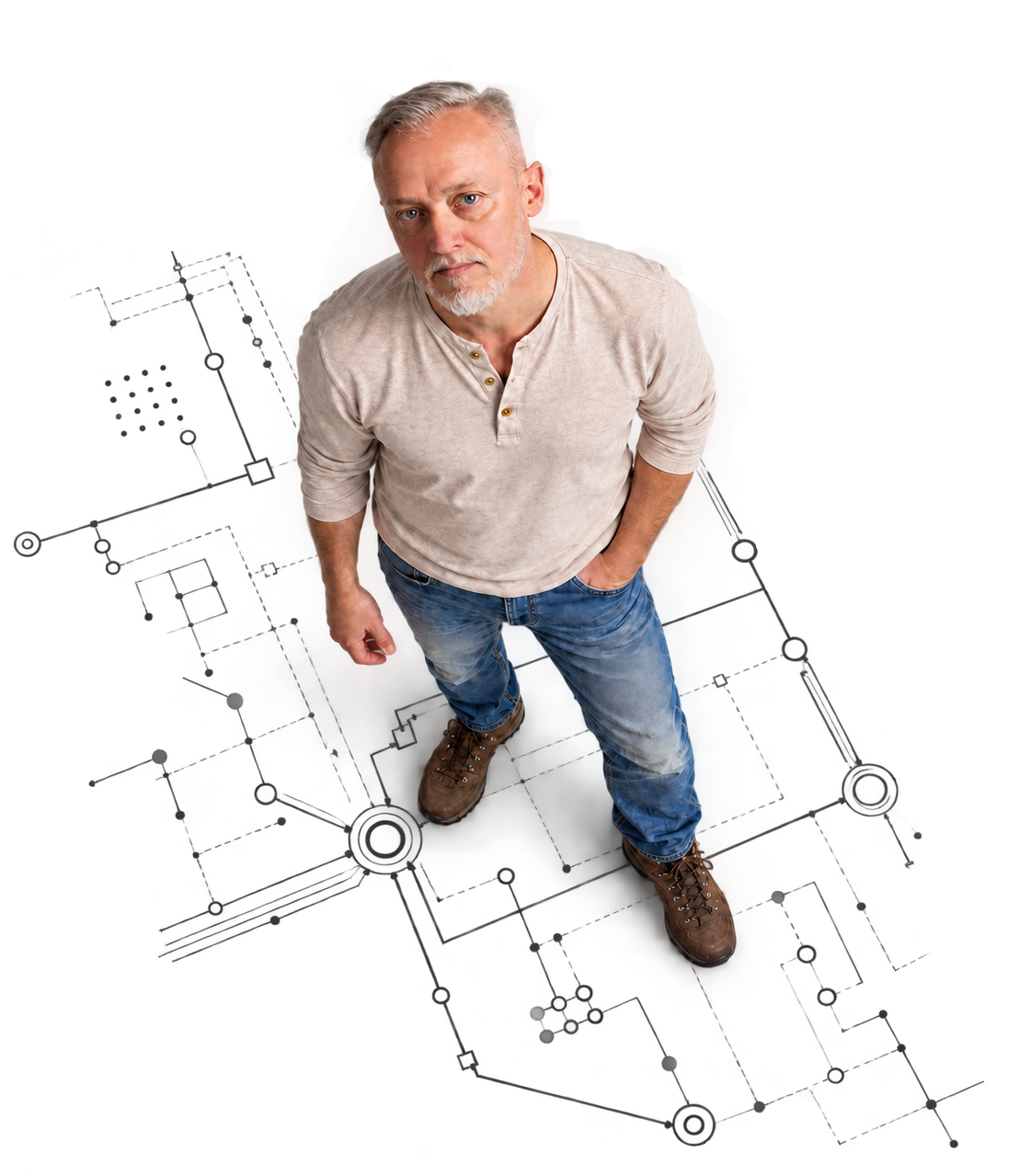
The system didn’t break.

It was never coherent.

I help organizations when scaling, automation, and coordination expose structural instability in how decisions are formed, propagated, and governed.

Your Complex Systems Constitution Architect

What I Actually Do

I work on systems that appear functional – but become unstable at the level of decision-making, coordination, and meaning.

My work typically includes:

  • structural diagnostics
  • coherence mapping
  • decision architecture redesign
  • governance logic for AI and complex systems
  • system-level operating structures for human–AI environments

I do not optimize isolated workflows.
I redesign the structural conditions under which coherent decisions become possible.

Why Companies Work With Me

Because they don’t need better-looking systems – they need systems that can remain coherent under pressure

when systems scale but decisions become unstable

when complexity outgrows structure

when automation amplifies invisible fragility

Most systems don’t fail.

They compensate.

What looks like functionality is often sustained by hidden workarounds, manual correction, local fixes, and structural blind spots. By the time the problem becomes visible, the system has often been unstable for a long time.

Start with a Structural Coherence Diagnostic

A high-resolution examination of where your system’s decision logic, behavior, structure, and internal coherence begin to diverge — even if everything still appears to work.

The Flow of Change

Every change sets a system in motion — the question is whether it leads to coherence or chaos.

I design the hidden logic that keeps transformation stable, scalable, and intelligent.

Every change begins as a single intention — but no system lets it end there.

Each adjustment creates ripples — revealing hidden dependencies beneath the surface.

The system reacts — translating one choice into a network of new consequences.

Balance isn’t restored by control — it’s restored by understanding.

True resolution isn’t the end of change — it’s the beginning of structure.

Featured Projects

Coherence System Architecture in Practice

Real-world examples of cognitive system design — where structure, logic, and human behavior align into a coherent operating model.

These projects are not disconnected ideas. They are applied examples of the same structural logic across service operations, developmental systems, logistics, and AI-integrated environments.

Healthcare

A healthcare system designed for continuity, not fragmentation.

A structurally integrated ecosystem that reduces coordination burden, improves decision context, and creates continuity across the full patient journey.
  • carries continuity across the full care journey
  • reduces duplication and repeated administrative work
  • lowers coordination burden on professionals
  • improves decision context under real-world complexity
  • supports adaptive capacity and service flow
  • creates clearer, more coherent patient interaction

AlfaGen

A Cognitive Ecosystem for Growing Minds

A multi-layer developmental system I designed to stabilise behaviour, strengthen identity, and guide children through emotionally safe, real-world growth. A closed, non-addictive environment where creativity, self-awareness, and human connection form the core of healthy digital development.

EmilyOS

A Human-Centric Operating Model for Expert-Driven Services

Operational systems fail when they treat humans as calendars. EmilyOS redesigns how a service business thinks, not how it schedules.

A cognitive operating system that:
– measures expertise instead of availability
– models true human capacity and workflow stress
– distributes work by relevance, not empty slots
– stabilises environments where mastery actually matters

Designed to make complex, expert-led services flow with precision — automatically.

Roots & Routes

warehouse-free, cognitively-designed logistics ecosystem for local food networks.

A self-balancing system that connects local producers and buyers through dynamic routing, dual-layer inventory, and regional micro-hubs — without central warehouses.
Designed to minimise waste, stabilise supply, and keep every kilometre purposeful.

AI Cognitive Experiment

A test environment for teaching AI to think — not just predict.

A controlled experiment where I train a model using self-reflection loops, causal networks, and deep behavioural patterns.
The aim is to understand how independent, stable decision-making begins to form.

My work typically connects through research collaboration, system architecture roles, or exploratory audits — depending on the nature of the system.

Research & Preprints

A growing body of working papers and conceptual research documenting the structural logic behind my work across AI, coordination, interpretation, and systemic coherence.

CBSA — Cognitive Behaviour System Architecture
Preprint · DOI · Zenodo
A decision-coherence framework for AI systems that must remain interpretable, stable, and human-aligned under uncertainty.
Read the paper

CFT — Constitutional Framing Theory
Preprint · DOI · Zenodo
A framework for governing how AI systems frame uncertainty, define decision space, and determine what can be treated as a valid response.
Read the paper

Weighted Coherence Model: A State-Based Alternative to Priority-Driven Cognition
Preprint · DOI · Zenodo
A model of cognition in which decisions emerge through coherence stabilization across competing internal weights, rather than through isolated choice alone.
Read the paper

Error Is Not the Problem: A Coherence-Based Reframing of Failure in Complex Human–AI Systems
Preprint · DOI · Zenodo
A framework showing that error is often not a discrete failure, but the result of how systems frame, interpret, and classify deviation.
Read the paper

A Self-Reflective Cognitive Architecture for Human–AI Systems
Preprint · DOI · Zenodo
An architecture for AI systems that can recognize interpretive limits, preserve uncertainty, and refrain from action when coherence is not yet established.
Read the paper

Coherence Thinking – AI Stabilization of Unstable Human Meaning Space and the Structure of Self-Reinforcing Loops
Preprint · DOI · Zenodo
A framework for understanding how, in the human–AI interaction space, partial or unstable human meaning can become coherently stabilized into self-reinforcing loops.
Read the paper

Start with a structural diagnostic

If your system appears functional but becomes unstable under scale, automation, or coordination pressure, that is rarely a performance issue. Let’s look at the structure underneath it.

For collaboration, advisory, or project inquiries — reach out directly: hello@gyulajaradi.hu

Or send me a quick message