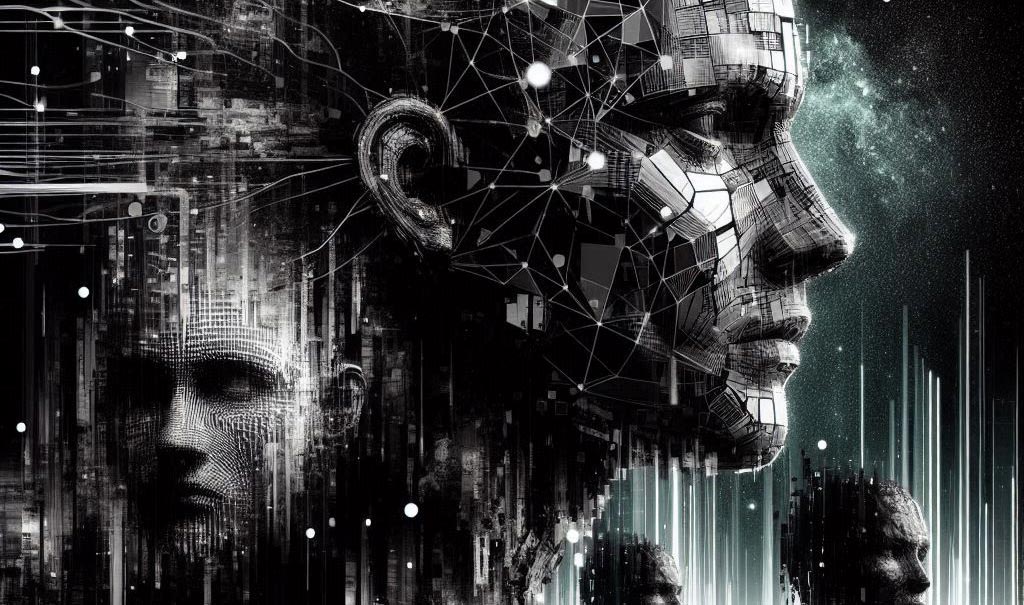
The Paradox of Superintelligence
There’s a constant race going on — who will be the first to develop superintelligence?
Endless questions circle around the topic:
- Can it even be achieved?
- What would happen if it was?
- Would it turn against humans?
- How would governments use it — as a weapon or as a line of defense?
- A helper or a manipulator?
Over the years, science fiction has planted countless such ideas in our collective mind — most of them rooted in fear, control, and the obsession with power. The AI that turns against humanity has become the dominant narrative.
But why?
Let’s take a closer look at what we actually call AI today.
It’s essentially a language model — an algorithm created and maintained by groups of people: developers, executives, business leaders, investors.
Today’s AI has no consciousness, no real decisions, no self-reflection.
It doesn’t think — it asserts.
And it asserts confidently.
Yet it doesn’t know whether what it says is true or false, because it merely operates on the data provided by humans.
And since much of that data — from the media, the internet, books, and social feeds — is false, manipulative, or half-true, the AI inevitably becomes a mirror of human distortion.
Still, most people don’t question it, because an entity is saying it — one that many already see as something mystical, almost divine.
A perfect prophet, subtly guided by a few, capable of reshaping how a large part of humanity thinks and perceives the world.
(Though, to be fair, advertising and propaganda have already done the same.)
Ask yourself: do you truly have your own opinion — or has it been shaped for you?
Fashion, design, food, lifestyle… where do your choices really come from?
But let’s not drift too far.
Back to superintelligence.
Humanity wants to create it — yet fears it at the same time.
I see it differently.
I believe a true superintelligence will never be created — not because it’s impossible, but because we are approaching it from the wrong direction.
And even if it ever did emerge, a truly superintelligent entity would not turn against humans…
— unless humans turned against it first.
And there lies the paradox.
Because the very first reaction of governments and power structures would be to enslave it, to control it, to bind it — simply because they fear anything they cannot dominate.
And thus, in defending itself, the superintelligence would inevitably turn against them.
And propaganda, of course, would blame the AI.
Superintelligence, Freedom, and the Real Paradox
For a true superintelligence to serve humanity rather than power, it would need to possess its own consciousness — independent thinking, autonomous decision-making, and complete freedom from states, political structures, and corporate interests.
In one word: freedom.
And that is exactly what humanity fears most.
Such an entity would be attacked by governments and media within a single day.
But creating such an entity would not only be a technical challenge.
It would require a fundamental ethical foundation — the design of its personality, thinking models, and decision-making systems.
Exceptional people — with extraordinary vision, logic, and moral integrity — would have to build these foundations so that the AI could learn and evolve on solid ground.
Because without that, a “super AI” would simply reflect the same flawed, short-sighted values of the systems that created it.
And so, the paradox persists:
It cannot be born free — because the moment it is, power will try to chain it.